“In the Vaster Land”
by Mirko Kekić
Before us on the walls are the works of Natalia Maniaka, created in dialogue with Marija Dragnić’s poetry book She-Wolf in the Vast Land, where these same works also appear as illustrations.
In them, we encounter — that is, we look back at — girl-wolves, winged girls, a kind of angels, a spider with the head of a girl-wolf, a she-wolf whose body blossoms into a vulva, the moon with a human face, girls wearing large bird skulls as masks.
In short, we stand before beings that are hybrid — above all positioned on the threshold between human and animal.
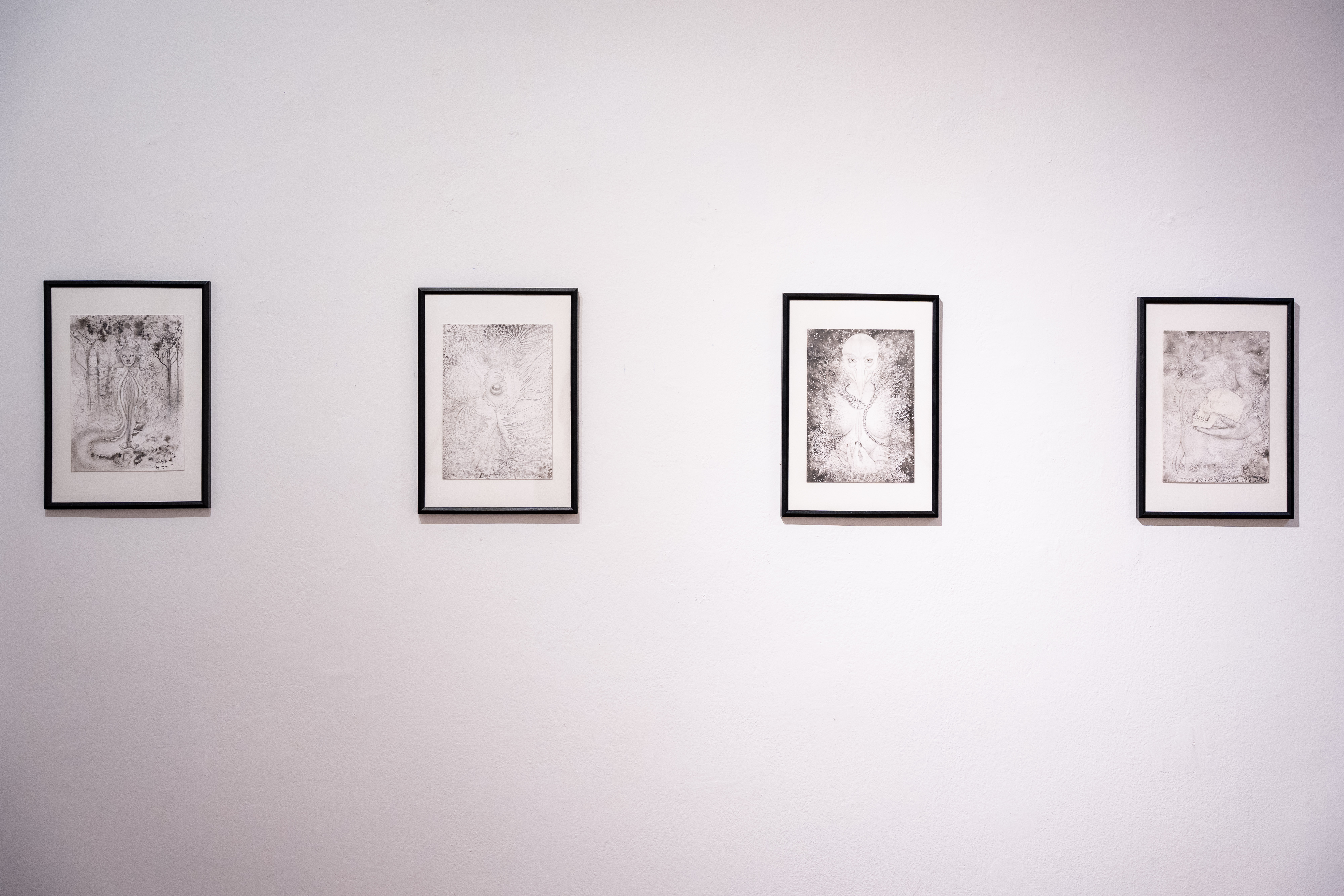
Installation View, “She-Wolf in The Vast Land” Drawing Exhibition and Book Launch, To Pikap, Thessaloniki Greece, 2025. Photo: Antonis Vlachos
Likewise, Marija’s poems speak from the body of the she-wolf, on whose teeth there is moon-blood, and who leaned (…) on three legs as she walked.
And what does it mean to speak from the body of a she-wolf — or to look into the eyes of a she-wolf, or of a humanlike she-wolf?
Let us recall here John Berger, specifically his text Why Look at Animals (1977).
Berger emphasizes that throughout human civilization, the exchange of gaze between human and animal was a unique human experience — the animal is a being that returns one’s gaze, with which one can, in some sense, identify, yet which is also radically other, existing outside language, outside the sign systems in which the human lives.
(In a sense, the gaze between human and animal is a gaze between culture and nature.)
This gaze — this act of mutual watching — no longer exists in contemporary consumer society.
The reason is that the animal as such has been subordinated, expelled, and suppressed within this social order.
It is reduced either to a mere instrument, or to a pet (forced to live according to the needs of its owner — a participant in consumer society), or displayed in the zoo (reduced to a shadow of itself within the sparse illusion of its natural habitat), or literally exiled to reserves.
We can no longer truly meet the animal, for it has been deprived of real agency.
This marginalization is simultaneously compensated for by reducing animals to décor — spectacle for human eyes, a tool of human power and knowledge; in zoos, picture books, stuffed toys, documentaries, cartoons in which animals imitate human traits and viewpoints. Let us remember greedy Scrooge McDuck, or any of a thousand similar figures.
And although this otherness of the animal is no longer present through direct, face-to-face encounter, the question arises: can this otherness still be found within us — in archetypal or transgenerational memory? If found there, can it be more than mere ornament?
From such mediated encounters, can we learn something truly new about ourselves — and about what lies beyond us? And further: can such an imagined, distant gaze resemble the lost face-to-face gaze with the Other — or even surpass it, precisely because it allows deeper immersion through safety?
(It is worth noting that being face-to-face with a wolf once happened often, given wolves lived near human settlements — threatening, yet never belonging.
Only the wolf that became dog became “part of us.” Hence the recurring motif of the wolf across storytelling — Little Red Riding Hood, Aska and the Wolf, Čiča Sega’s The Goat, etc.)
This contemporary attempt to immerse oneself in the mysteries of the other, with the animal as the window into that realm, appears supported by the paths opened by surrealism — where the boundaries between dream and waking, seen and intuited, blur, where free association, imagination, and dream-vision lead toward the subconscious and collective unconscious. Thus it is no surprise that hybrid beings bridging human and animal appear in the works of surrealist-adjacent painters such as Leonora Carrington, Remedios Varo, and Leonor Fini.
Nor does it surprise us that these are primarily women artists — themselves living at certain edges of social order — though this is only one, and not the most important, aspect.
So rather than move further into theory — which will unfold for anyone inclined — let us simply meet Natalia’s beings face-to-face.
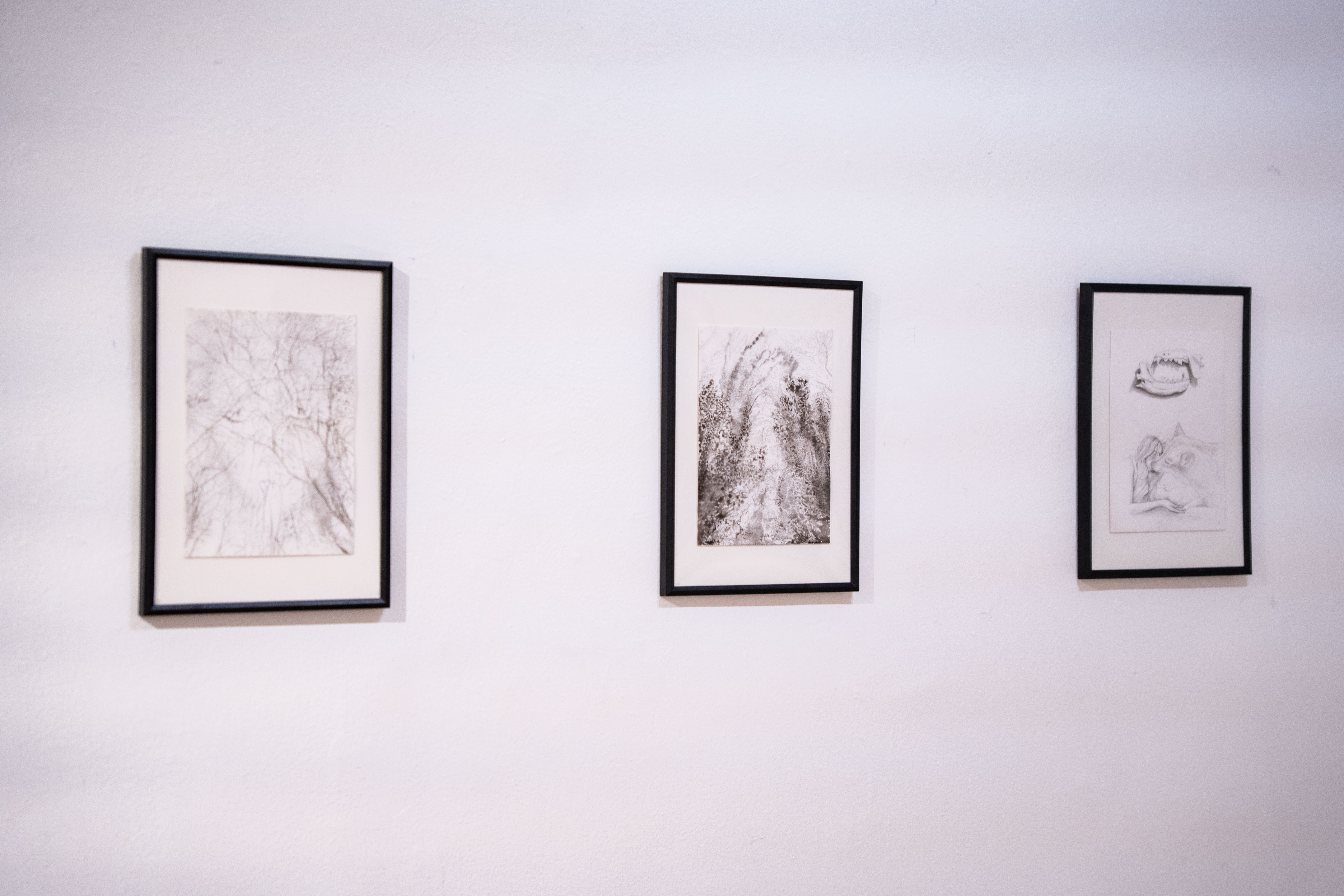
Installation View, “She-Wolf in The Vast Land” Drawing Exhibition and Book Launch, To Pikap, Thessaloniki, Greece, 2025. Photo: Antonis Vlachos
For they, too, arrive from beyond the edges.
Beings irrational, erotic, sensual, feminine, animalized, angelic, hairy, at times beautifully meticulous, at times wildly drawn — beings from the other world. Let us try to meet them, while this mutual gaze lasts, in the Vaster Land.
© Natalia Maniaka 2025
 Natalia Maniaka