The Flower Jar : Reimagining Pandora –
A Reflection on Hope and Archetypal Myth
by Natalia Maniaka
When we think of Pandora, we often think of catastrophe. We remember the opening of the jar and the release of suffering into the world. Far less attention is given to what remained inside: Hope.
This overlooked detail became the starting point for my research into the myth of Pandora, its many interpretations, and the ways in which her image has been reshaped over time. Inspired by a painting of Dante Gabriel Rossetti’s Pandora (1871), I began tracing the evolution of the myth from antiquity to the present day.
In Hesiod’s Works and Days, Pandora is created by the gods at the command of Zeus as a response to Prometheus’ theft of fire. Endowed with gifts from the Olympians, she is sent to humanity carrying a sealed jar. When the jar is opened, countless hardships escape into the world, while Elpis (Hope) remains inside.
Over time, Pandora became one of the most influential female figures in Western imagination. Her story has often been interpreted as a cautionary tale about curiosity, temptation and disobedience.
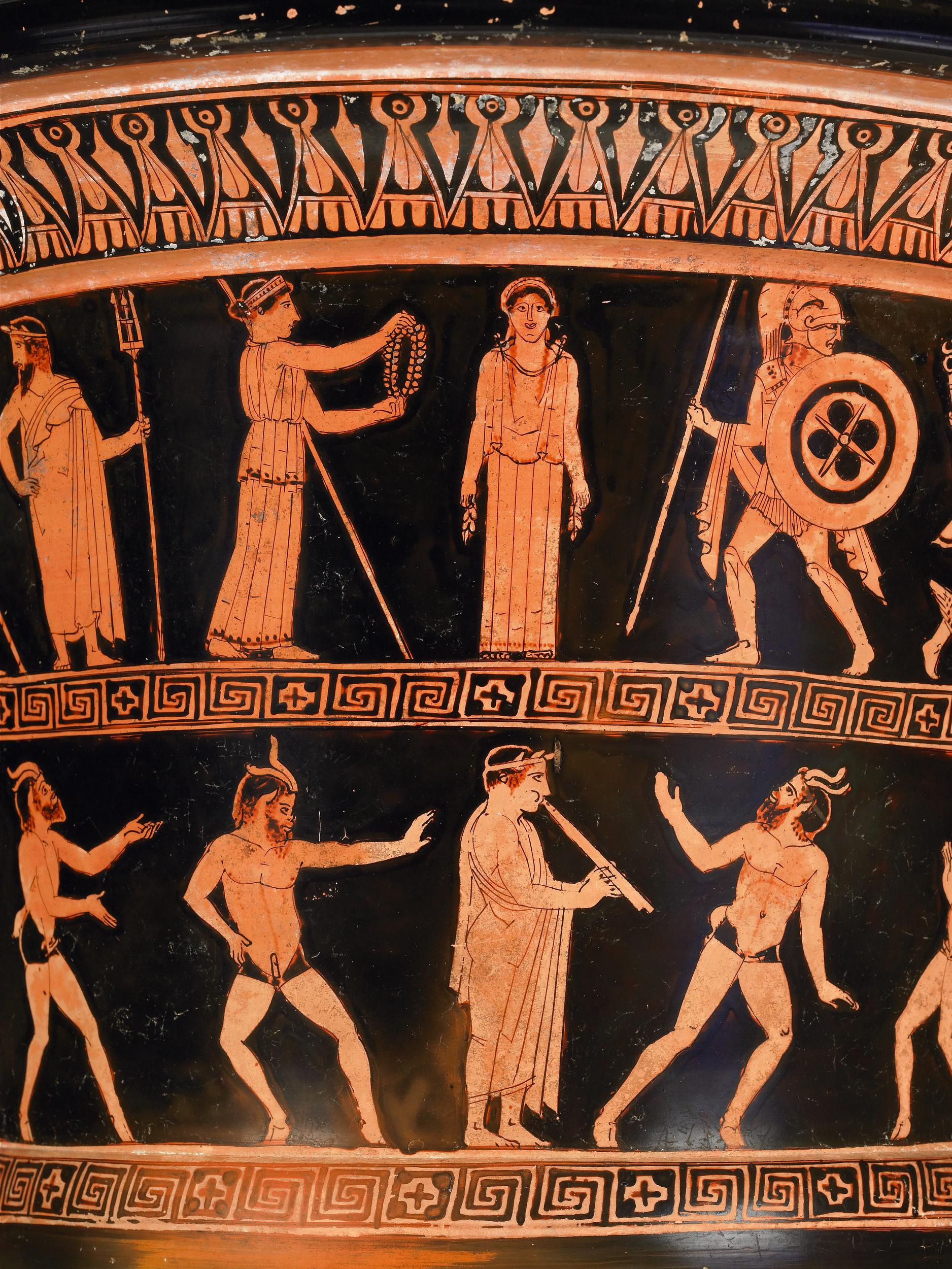
Attic red-figure calyx krater (detail) above, the creation of Pandora, below, a chorus of Pans, attributed to the Niobid painter, 460−50 BCE. London, The British Museum
In Pandora’s Jar: Women in the Greek Myths, classicist Natalie Haynes revisits the women of Greek mythology and challenges many long-standing assumptions surrounding their stories. In discussing Pandora, she points to lesser-known sources that suggest a striking alternative interpretation of the myth: rather than containing evils, Pandora’s jar may originally have been filled with good things.
When the jar is opened, self-control, trust and other virtues fly away, which is why they are so rarely found among mortals. Only Elpis (Hope) remains behind.
Pandora is frequently portrayed as responsible for humanity’s suffering, yet the myth raises an important question : how much agency does she actually possess?
If Pandora is created by Zeus as part of a divine plan for revenge, can she truly be held accountable for its consequences? What interested me most, however, was not Pandora herself but the contents of the jar.
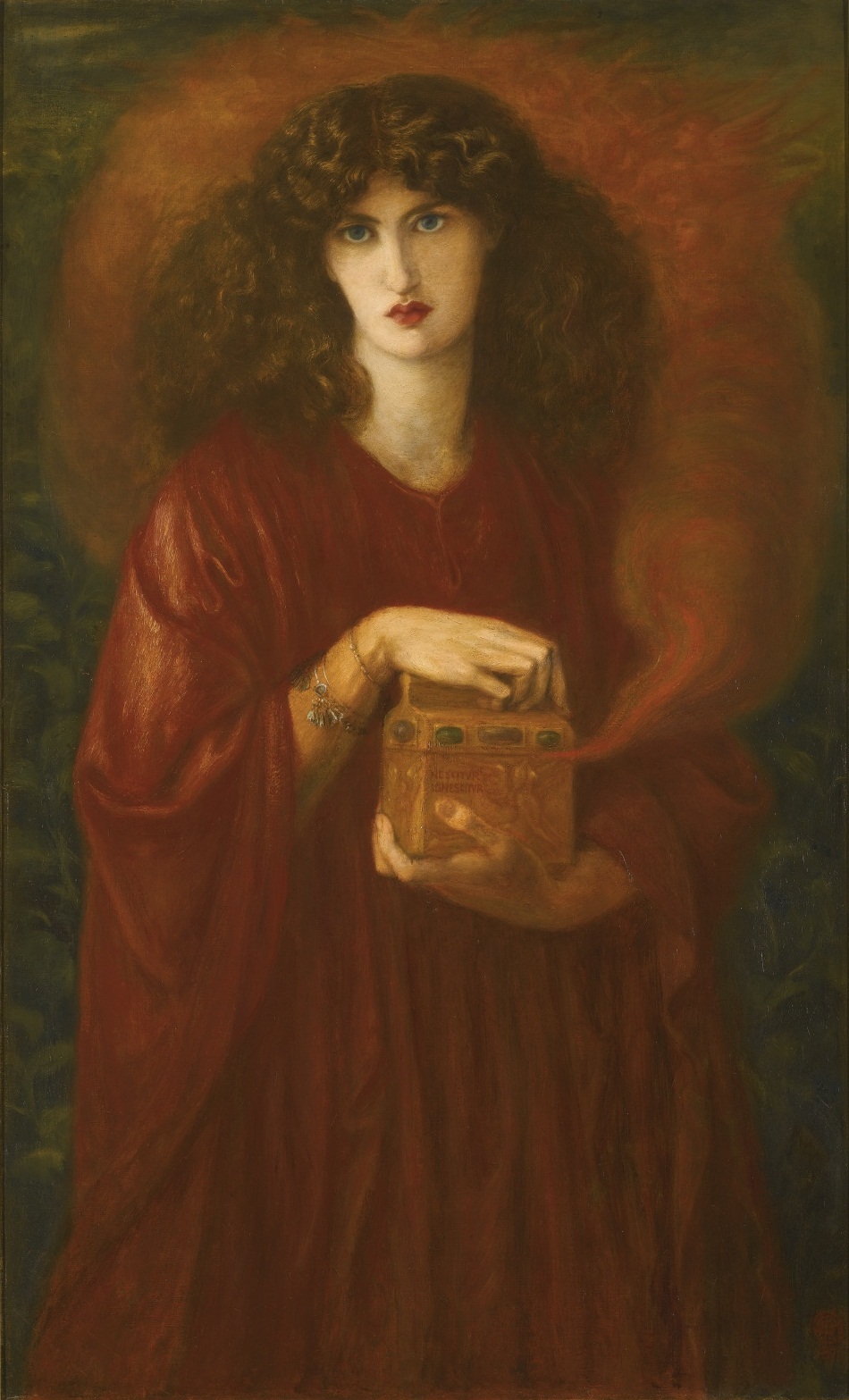
“Pandora” (1871), oil on canvas, Dante Gabriel Rossetti (1828-1882)
Among the many artistic interpretations of Pandora, Rossetti’s 1871 painting remains one of the most recognizable. Instead of a jar, Pandora holds a richly decorated golden casket, which she appears to be in the process of opening.
A faint coil of smoke emerges from the narrow gap between the lid and the box, suggesting that whatever lies inside has already begun to escape. The inscription Nascitur Ignescitur (“born in flames”) further emphasizes the ominous character of the scene.
While Rossetti emphasizes the mystery and potential danger concealed within the casket, Odilon Redon’s interpretation shifts attention elsewhere. Rather than focusing on the contents of the vessel, Redon places Pandora within a dreamlike world of flowers, colour and symbolism, where the myth seems to dissolve into a more poetic and contemplative vision.
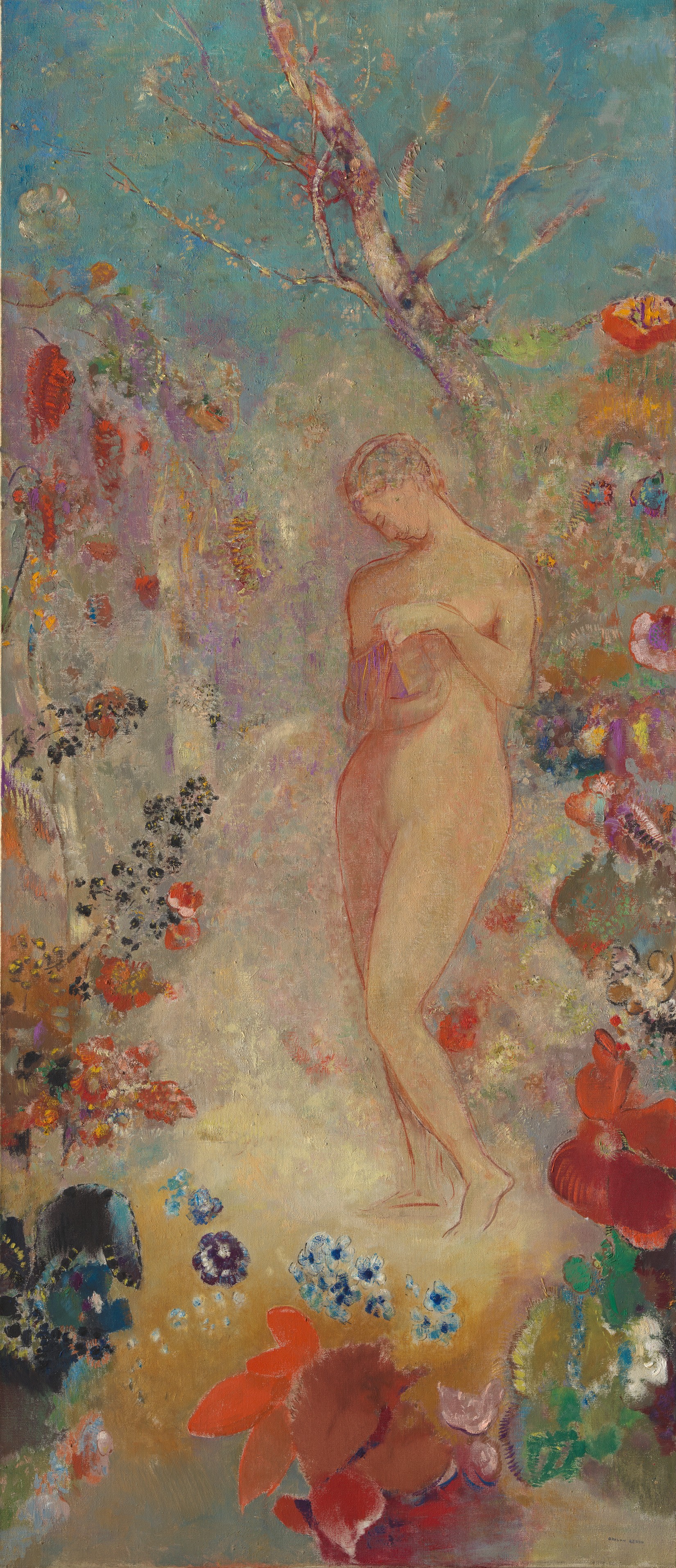
“Pandora”, oil on canvas, Odilon Redon, c. 1914
Unlike many nineteenth-century depictions of Pandora, which focus on the dramatic moment before or after the opening of the jar, Redon’s interpretation appears less concerned with narrative and more with atmosphere.
Surrounded by flowers and immersed in a dreamlike environment, Pandora becomes part of a larger symbolic landscape.
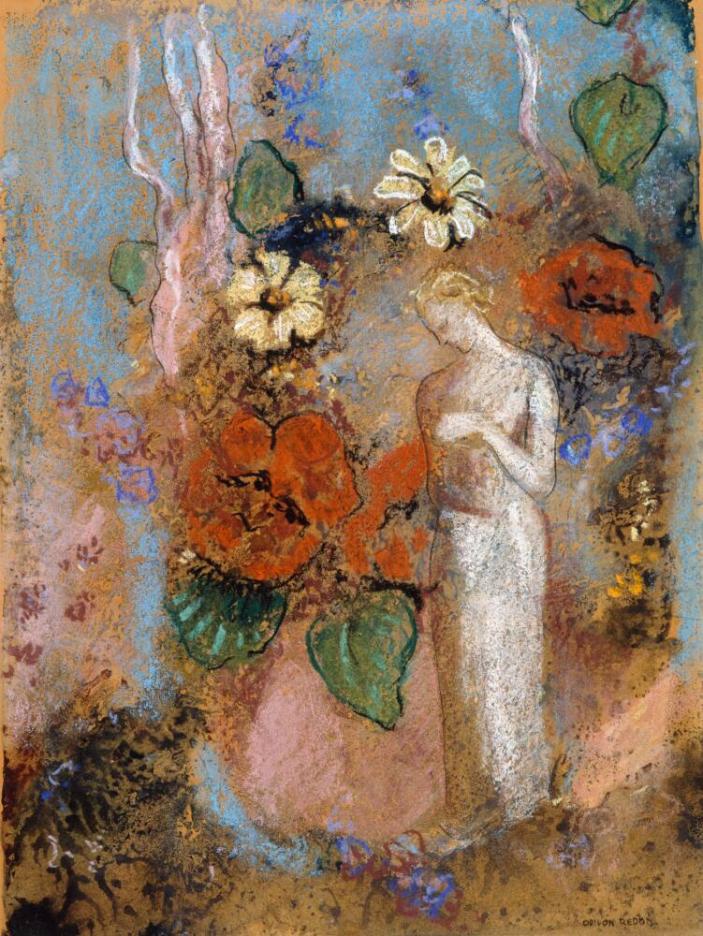
“Pandora (Femme Debout Dans Les Fleurs)”, pastel and charcoal on board, Odilon Redon, c. 1890-1905
This shift away from a literal retelling of the myth was particularly interesting to me. Rather than presenting Pandora as a figure defined by guilt or responsibility, Redon’s painting seems to place her within a world of transformation, ambiguity and organic growth.
During the development of my own painting, I found myself gradually moving away from the familiar image of Pandora as a fully human figure, and became interested in depicting it as gradually evolving into a hybrid form.
“Flower Jar”, oil on canvas, 120 x 100cm, 2025
Human, animal and botanical elements began to coexist within the same body, making it increasingly difficult to read the image through simple oppositions such as good and evil.
Regarding symbolic associations of colour, purple is described as a colour that brings together opposites. The ancient Greek purple, a dark reddish colour, was thought to be suitable for appeasing and honouring the dead and the fearsome gods of the Underworld.
As a combination of red and blue, purple can be understood as a meeting point between passion and reason, earth and sky, instinct and contemplation. This duality resonated with my broader interest in Pandora as a figure who resists simple oppositions. She can be a symbol of curiosity, blame, female agency, innocence, or forbidden knowledge.
Like many mythological figures, Pandora’s story does not offer definitive answers. Instead, it remains open to renewed interpretation.
© Natalia Maniaka 2025
 Natalia Maniaka